AMD Unveils Dense Geometry Format (DGF) for Next-Generation 3D Graphics
AMD has introduced a groundbreaking 3D graphics technology called Dense Geometry Format (DGF), designed to dramatically enhance geometric detail in digital visuals. This innovation aims to surpass the capabilities of current rasterization techniques, including advanced methods like tessellation, by optimizing how geometric data is stored and processed.
How Dense Geometry Format Works
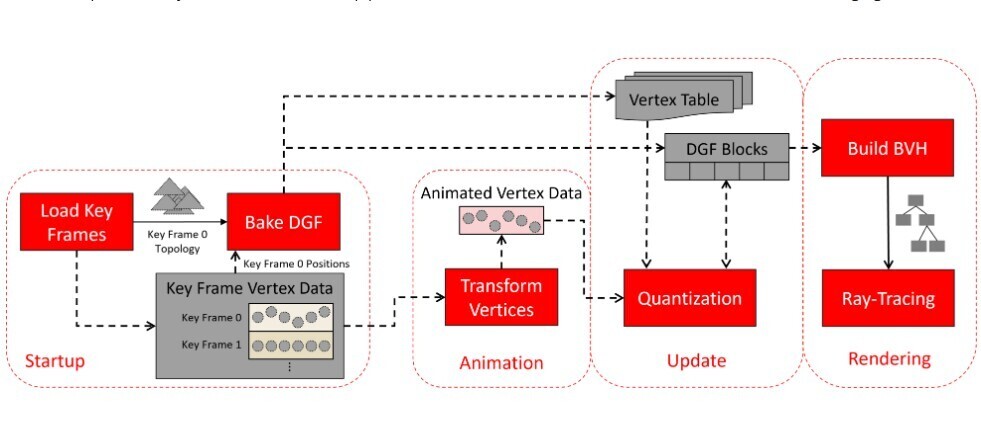
DGF achieves its efficiency by minimizing the resource footprint required for complex geometry. The format organizes small mesh segments—each containing up to 64 vertices and 64 triangles—into highly compact 128-byte blocks. These blocks efficiently encapsulate geometry data, vertex positions, and light topology, enabling a significant increase in detail without overwhelming system resources.
Comparison with NVIDIA’s Mega Geometry
While AMD’s DGF shares a similar goal with NVIDIA’s Mega Geometry, introduced with the "Blackwell" graphics architecture, the two technologies differ in scope and implementation. NVIDIA’s Mega Geometry is primarily focused on enhancing the geometry of ray-traced objects through a hierarchical data model. In contrast, AMD’s DGF is designed for broader use, supporting both rasterized and ray-traced objects, making it a versatile solution for a wide range of 3D graphics applications.
Hardware Support and Future Architectures
The research paper also outlines the hardware requirements for DGF. Currently, no existing AMD GPU architectures offer dedicated hardware acceleration for this technology. DGF is being developed with future architectures in mind, such as the anticipated "RDNA 5" or UDNA platforms. On GPUs lacking native hardware support, DGF operations can be executed via shaders. Although this approach introduces a minor performance overhead, it remains significantly more efficient than rendering the same level of geometric detail using traditional rasterization methods.
AMD’s Dense Geometry Format represents a significant step forward in 3D graphics technology, promising richer detail and more efficient rendering for future gaming and visualization experiences.